How collaboration helps researchers turn curiosity into health
The most meaningful discoveries rarely happen in isolation.
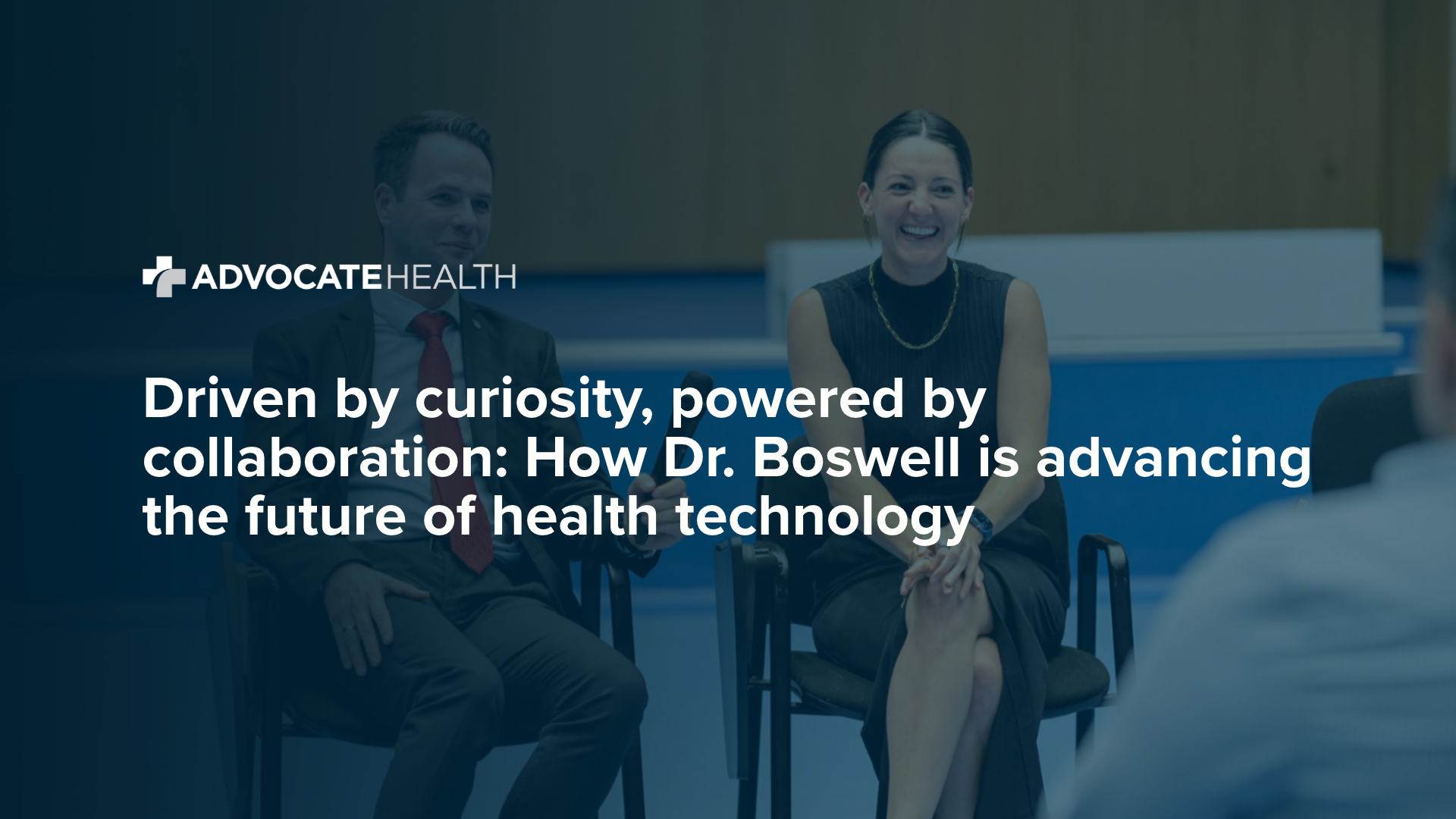
At Advocate Health and Wake Forest University School of Medicine, researchers work across clinical, academic and technology-focused environments to tackle complex challenges and improve patient outcomes. For Dr. Boswell, assistant professor of biomedical engineering and researcher within the Center for Remote Health Monitoring, that collaborative approach has created opportunities to transform scientific curiosity into research with real-world impact.
Inspired by her grandmother’s experience using an upper-limb prosthesis, Dr. Boswell built a career exploring the intersection of biomechanics, health technology and patient-centered research. Today, she collaborates with clinicians, scientists and engineers to develop innovative ways to better understand human movement and health beyond traditional laboratory settings.
A personal question becomes a career
Growing up, Dr. Boswell watched her grandmother adapt to life with an upper-limb prosthesis. As the technology evolved, she became fascinated by the possibilities and limitations of devices designed to improve quality of life.
That early curiosity eventually led her to study biomechanics and pursue a career in research. As an undergraduate at the University of Akron, she discovered a passion for asking questions, building experiments and exploring what was still unknown.
“I discovered I loved identifying the boundaries of what we know, asking questions and designing experiments to push those boundaries a little further,” she said.
That curiosity led her to Stanford University, where she completed both her PhD and postdoctoral training before beginning the next chapter of her research career.
Building research that reaches beyond the lab
Since joining Advocate Health, Dr. Boswell has focused on laying the foundation for her research program while building partnerships across disciplines. Her work explores how technologies like smartphone-based motion capture and wearable sensors can support clinical research and create new opportunities to improve patient care.
What excites her most is the ability to collaborate with experts from across the organization. “One of the most exciting things about being here is discovering how many talented people are doing interesting work and finding opportunities to bring our expertise together,” she said.
Those connections are helping create new opportunities for innovation. By bringing together clinicians, researchers and technology experts, teams can tackle complex challenges while accelerating the translation of new ideas into meaningful solutions. For Dr. Boswell, that collaborative approach has been one of the defining characteristics of her experience so far.
Turning curiosity into practical research
Today, Dr. Boswell’s research focuses on how emerging technologies can help researchers and clinicians better understand movement, health and recovery in everyday settings.
Her work explores the use of smartphone video, wearable sensors and artificial intelligence to capture meaningful data outside traditional laboratories. By making movement analysis more accessible and scalable, these technologies have the potential to expand research opportunities and create new pathways for improving patient care.
For researchers, this type of work represents an opportunity to bridge disciplines, combining engineering, technology and clinical research to address real-world health challenges.
Collaboration that keeps people at the center
What makes Dr. Boswell’s work possible is collaboration.
At Advocate Health, researchers can work alongside physicians, engineers, clinical teams, data scientists and technology experts, bringing different perspectives together to explore questions with the potential to improve patient care.
“One of the most exciting things about being here is discovering how many talented people are doing interesting work and finding opportunities to bring our expertise together,” Dr. Boswell said.
For her, that collaboration is most meaningful when it translates into a difference people can feel in their everyday lives. One project that continues to stand out involved a behavioral intervention designed to help individuals with osteoarthritis rethink how they approached movement and physical activity.
“Hearing from participants who felt hopeful again, regained confidence in their bodies or got back to activities like playing with their grandchildren was incredibly meaningful,” she said.
Moments like these connect the technical and human sides of her work. While technology can help advance research, bringing together the right people, perspectives and expertise can help turn new ideas into meaningful improvements in health and quality of life.
A connected environment for research and discovery
When evaluating opportunities, Dr. Boswell was looking for more than a place to conduct research. She was looking for an environment where collaboration could accelerate discovery.
She found that opportunity through the connection between Advocate Health, Wake Forest University School of Medicine and specialized research centers like the Center for Remote Health Monitoring. Together, these organizations create an ecosystem that brings clinicians, engineers, data scientists, clinical research teams and fellow investigators together to explore real-world health challenges.
That collaborative environment supports research across areas such as digital health, remote patient monitoring, biomechanics, movement science, clinical outcomes and emerging health technologies. By working closely with care teams, researchers can identify clinical needs, evaluate potential solutions and study how new approaches may improve patient care.
Advice for future researchers
For researchers considering careers in academia and health care, Dr. Boswell encourages curiosity, openness and a willingness to learn from others. One lesson from her mentor, Scott L. Delp, PhD, that continues to guide her work today is “People over papers.”
That mindset aligns closely with the collaborative culture she has experienced throughout Advocate Health and Wake Forest University School of Medicine.
Dr. Boswell’s journey began with a question about how technology could help someone she loved. Today, that same curiosity continues to drive research designed to improve lives, advance scientific discovery and shape the future of health care.